
Sensemaking
What it is and why it matters for social change

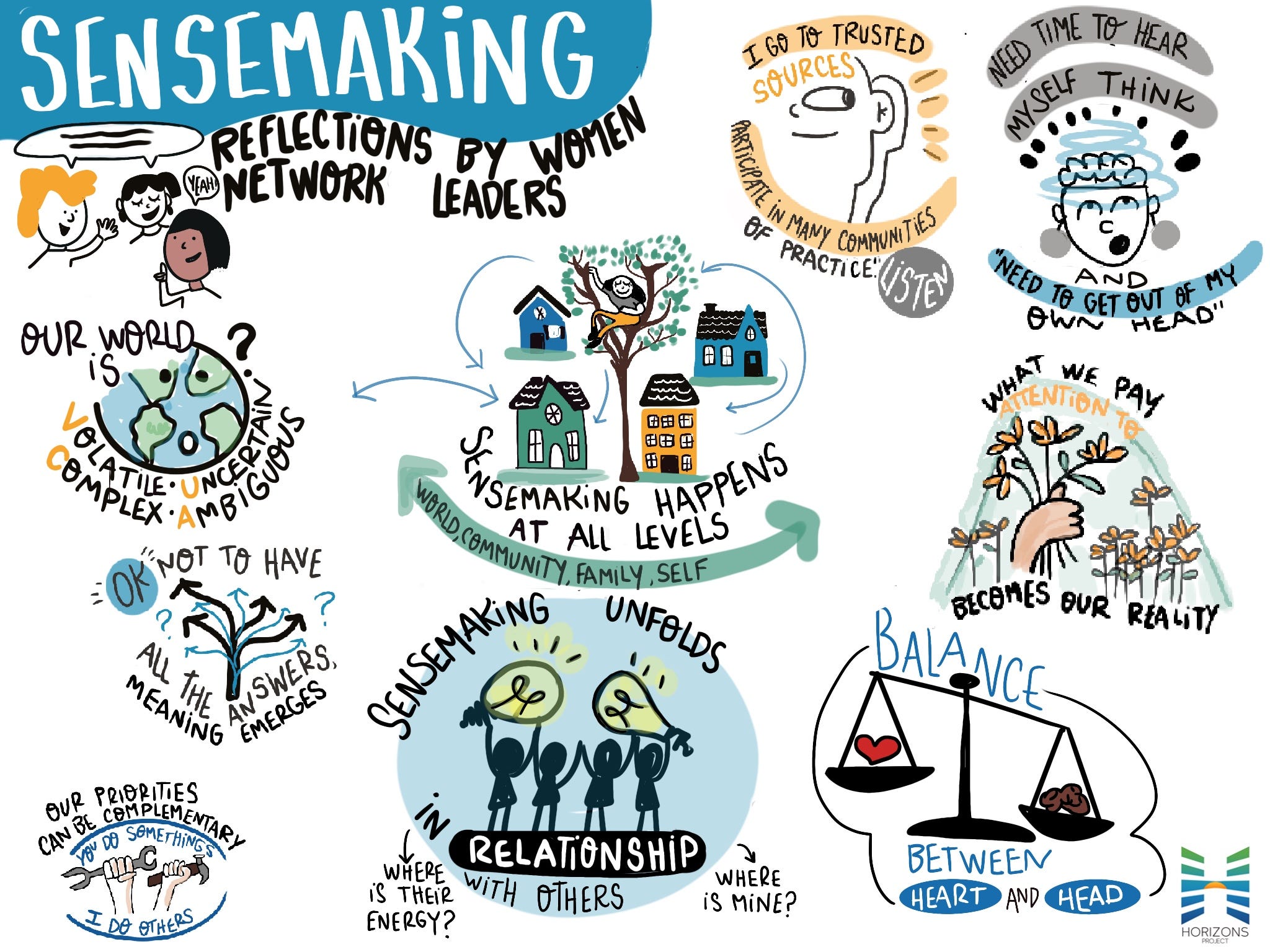
One piece of our work at the Horizons Project is “sensemaking.” As organizers and coalition-builders who believe in the power of emergent strategy, the practice of sensemaking is something that we are continually reflecting upon: What is sensemaking? What is its purpose? How do we do it better? How can it drive our adaptation? How can we share what we’re learning and doing with diverse communities?
So, what exactly is “sensemaking” and why is it important to organizers? First and foremost, we acknowledge that we are operating in a world filled with volatility, uncertainty, complexity, and ambiguity. Even if we weren’t such a small team, we could never hope to fully wrap our minds (and arms) around this volatile, uncertain, complex, and ambiguous world. If our goal at The Horizons Project is to provide value and help strengthen connections and collective action within the social change ecosystem, we must find ways to constantly scan and interpret what’s going on within the system to then strategize, act and adjust as needed. Sensemaking is one of those practices. While there are many methodologies and definitions of sensemaking, we are drawn to the approach of Brenda Dervin that is based on asking good questions to fill in gaps in understanding, to connect with others to jointly reflect on our context and then take action.
There is no one way to conduct sensemaking. In fact, this word means many things to different practitioners. So, at a gathering we asked a group of trusted women in positions of network-wide leadership, to share with us how they think about sensemaking, and what it looks like in practice for them. In a series of short, personal testimonials, Horizons captured these insights in our very first podcast series, which we are excited to circulate again.
Several themes emerged from those conversations that we find inspiring, and indicative of the ways women show up as leaders, naturally holding nuance and seemingly contradictory practices that can all be equally true.
Sensemaking is a balance between heart and head. There are many ways of knowing. Placing too much emphasis on analytical skills and tools, and over-intellectualizing how we discern what’s happening around us can be a barrier to also sensing with our emotional intelligence. How do we feel about what’s happing in the world, and how are others’ feeling? Sensemaking involves empathy, and yet radical empathy can also lead to overwhelm and paralysis. Staying within our analytical selves is often a way of protecting our hearts and can help stem the anxiety that comes from uncertainty and volatility. Finding that balance isn’t always easy, but some useful tools are with the arts or through physical activity, finding creative ways to connect to our bodies that can spur new insights.
Sensemaking is not the same as aligning. When working within complex ecosystems with diverse networks and coalitions, we are not always called to make sense in order to identify points of alignment. Having different theories of change is healthy and needed. Naming all of our distinct definitions of the problem and then allowing for a diversity of approaches to unfold is an important network leadership practice. Sensemaking in coalitions does not always have to lead to collective action, but we can uncover shared values when we listen deeply.
I am a person who believes in living as one would want to see a life lived.
Sensemaking takes place externally and internally at all levels. We all go to trusted sources to help make sense of what’s happening around us. Participating in a wide array of communities of practice is useful. We read, we listen, we share. Sometimes we have time to go deep into topics, and other times we are broadly scanning and skimming many sources. But we also need quiet time to hear our own voices through all the noise to take time to process and make sense at the level of our individual selves. This helps us stay coherent with our values and lets our lives represent the world we want to help create.
…the sun blazes
for everyone just
so joyfully
as it rises
under the lashes
of my own eyes,
and I thought
I am so many!
Sensemaking involves awareness of energy flow. It’s okay to feel the discomfort of uncertainty. And yet, we pay careful attention to what gives us energy on a personal level. We are also continually observing what others are doing that seems to be garnering their energy and inspiring others. If we believe that what we focus on eventually becomes our reality, we need to be careful about doomscrolling or focusing too much on the negative. Broadly, engaging in sensemaking doesn’t mean that we must feel responsible for doing everything and solving every problem ourselves. Elevating the priorities and perspectives of others is a way of supporting collective sensemaking.
Sensemaking is a commitment to being in relationship with others. The human dynamic of building connection is an important practice to create the conditions for effective sensemaking. Playful spaces that allow for us to laugh and let loose – to be embodied human beings as our full selves, this helps to later know who to go to for information and to navigate challenges together. We might think we always have to be “productive”—that we should come together to do mapping of our system, should be identifying intersections for partnership, should be sharing our workplans and formal analysis. But sometimes sensemaking looks like a dance party or just having a meal together. Prioritizing relationships and fun is integral to the work.
Sensemaking includes observing patterns of power and privilege: Being an “outsider” or coming from different cultural, racial, or economic backgrounds can help shed light on power dynamics that otherwise might not be seen. Sensemaking by cultivating spaces for individual storytelling, raising the voices of those perspectives not always heard and stitching together many stories to understand common and divergent narrative streams helps to observe those patterns and realign our collective action.
Sensemaking requires authenticity and grace. If we are making sense of “what to do” without a complete picture or levels of certainty (either as individuals or in coalitions), then we will often make mistakes. Giving each other grace to navigate these challenging moments is key: we must allow for incomplete conversations and yet still act; we may choose one imperfect theory to test out and see what happens; we often must agree to disagree and realize that there is not one perfect path that we should all be working on together. Sensemaking in community is also an act of “having each other’s backs” and assuming the best intentions of others doing their best to make sense in their own way. This works best when we act with authenticity, which naturally shines through.
Here are some additional resources on sensemaking to check out: